
Weekly reading (w/c 10/11)
Debt, extractivism, subcultures + COP links

Resource extractivism is being accelerated by the international debt system. The article focuses on Argentina under Milei, but other vulnerable countries are also at risk.
The IMF is central to this story: rapidly shedding its green veneer, a renewed emphasis on creditor interests means countries are pushed to mine and drill (and adopt austerity measures, naturally) to raise cash. Then there are the terrifyingly-named ‘vulture funds’, investment firms who swoop in to buy discounted debt so they can then sue the (usually crisis-stricken) debtor country for full recovery through protracted litigation. The US also features heavily — for refocusing the IMF away from environmental issues, and for driving extraction (e.g. of lithium) in allied countries in the pursuit of independence from Chinese supply chains.
Lots more in here, well worth reading. From The Break-Down, a recently-launched publication on ‘capitalism, nature and the climate’ hosted by Common Wealth. Note: I needed to give my email address to subscribe (for free) to read.
*
Adam Tooze on the political dimensions of China’s rapid solar build-out. Its solar manufacturing capacity is already 50% higher than the IEA thinks is needed for the whole world to hit an ‘optimised’ Net Zero trajectory, enabling many emerging economies to electrify rapidly, and on the cheap (some have now leapfrogged the US).
But this has been a top-down initiative, with environmental activism quashed. In Tibet and Xinjiang, green modernisation has been used as a tool of ‘coercive state-building’: vast energy and manufacturing projects in these regions lay claim to the land on the Chinese state’s behalf, with Han Chinese pushed to ‘settle’ there for work etc. This is still very much an extractivist model of development — perhaps the apotheosis of it:
Whatever, China’s authoritarian environmentalism may be, it is not a break with the basic premise that large-scale organized modernity requires the subordination of natural resources and the irreversible incorporation of traditional and indigenous communities into what Beijing sees as the common national and human project of modernization.
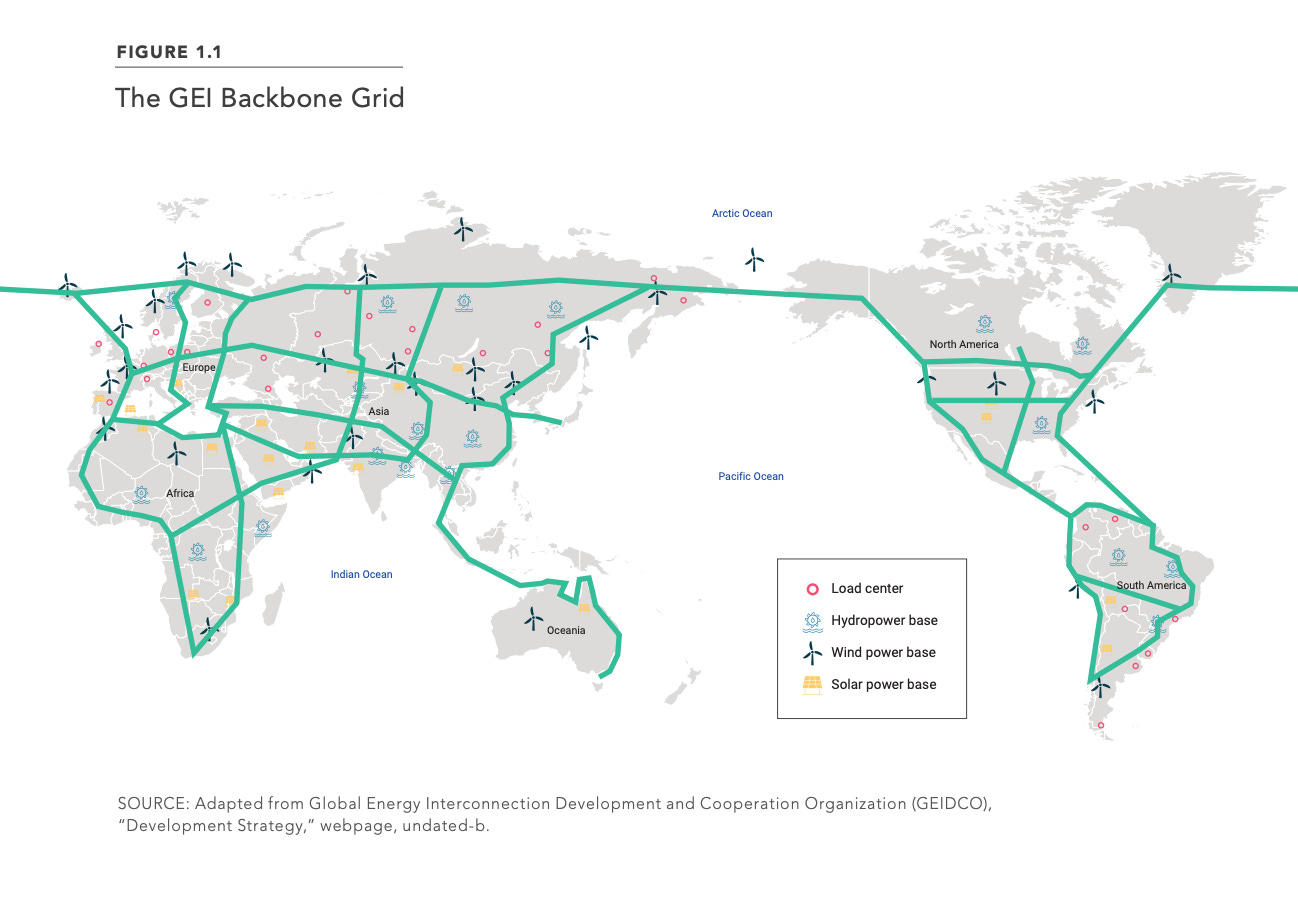
Globally, of course, it helps expand China’s influence. The map below is a Xi-endorsed plan for Global Energy Interconnection from 2015, presumably to be underpinned by Chinese infrastructure. Then there’s the potential for China to remotely control (e.g. switch off) some of its exported energy tech, the likelihood of which is apparently being debated by experts... So it’s all going very well.
*
An early pandemic piece (June 2020!) on the value of operational expertise in government. Argues that the effectiveness of national Covid responses wasn’t determined by regime type, but by how far governments combined ‘a participatory public culture of information sharing with operational experts competently executing decisions’. Long-term thinking also helped.
I feel there’s some crossover here with Dan Wang’s distinction between China as an engineering state and America as a lawyerly society (which is not to say that China’s approach is always the most adept for this emerging world — its response to Covid left a lot to be desired!). Part of a bigger picture of re-evaluating skills and governance approaches in the face of increasing complexity. My piece last week on systems in recent Hollywood films covered some similar ground.
*
Article from The Chow on the state of HK subculture. A really nice write up, covers a lot of ground. Especially interesting on where influential subcultures come from, which is something I’ve been keen to write about for a while.
I think the point is not just that they can come from places other than London and New York — which I agree with — but that they tend to come from constrained contexts in general (including in London/NY, drill being an obvious recent example). Subcultures, almost by definition, cannot be the product of ‘nepo babies’ or ‘institutional’ funding. But in a previous world they needed to pop up close to the metropole if they were going to get picked up and popularised (hence, in part the apparent prolificacy of the major cities). Now they can be more far-flung and still attract global attention, via social media and more widespread international travel etc.
The big question this raises, which isn’t really addressed in the HK case, is whether this increased global interconnectedness also smooths out the edges…my impression is that ‘the subculture’ is strong globally, but there are fewer obviously distinct and localised subcultures to point to (although they also still exist!).
Anyway, h/t to my Dad for this one, who somehow keeps up with this stuff despite being twice my age.
*
Other, COP-adjacent things (it is that week, after all…):
Rethinking COP. Two articles on how to do better. One a speculative investigation of how AI could be used to improve implementation. The other making the case for a redirection of resources towards local communities and initiatives (supported by higher taxation of the rich and cancellation of Majority World debt) — i.e. not reforming COP but ‘outgrow[ing]’ it.
More on solar. Low-cost solar and mobile ‘pay-as-you-go’ payments are apparently upending development assumptions in Sub-Saharan Africa by bringing electricity to smallholders and local communities without large-scale grid infrastructure. The writing here is (a) hype-y and (b) obviously AI-assisted, so I’m cautious. Plus some of his numbers are a bit weird. But seems plausible, possibly worth investigating in more detail.
Phytomining. Rather than digging a big and highly destructive hole, it appears you can mine metals by growing certain plants (there are 750 species of ‘hyperaccumulators’, which absorb huge quantities of metal from the soil) then burning them to get the valuable stuff from the ash. Research is apparently focused on nickel currently, but the same approach could be used for cobalt, copper and lithium. No assessment of the emissions involved from the burning here, that I can see, but it’s hard to be less environmentally friendly than traditional mining…
Other other things:
BBC. Some helpful context on the recent Trump drama. Although it offers little hope for the future of the broadcaster... (H/t my Dad, again.)
The ongoing popular science wars. So far aware of Harari, Diamond, Walker, Gladwell and now van der Kolk being debunked (or at least challenged — don’t personally have enough knowledge of each area to know). Is this because popular science inevitably lacks nuance? Is it a reflection of our contested information environment (who are we to believe?!)? Or is this just the cost of putting your head above the parapet where the whole world can see it? Might try and write about this at some point. Intrigued.
Mamdani (still). Last link on him for a while (promise!), but in my Tooze catch-up I saw he wrote an article on Zohran last week. Especially interesting on NYC’s rampant inequality. Highly related to my London piece from Friday, although he has more charts and figures to back it up…!

A note on programming: you might have noticed many more emails arriving from me than usual… I’ve been enjoying writing them (enabled by a small dip in paid work deadlines), but doubt this rate of output will be sustainable. Am planning to skip writing another essay next week to focus on our next Kinesis night (at Vespers in Peckham on Saturday, please come if you’re free!), getting back up to speed with Last Night in Tokyo, and actually speaking/replying to you all… I’ll still aim to get some links out next Sunday again.
Huge thanks to those of you who have been sending feedback, I really appreciate it. If you know someone who might be interested in this kind of content, feel free to share it with them.
This article comes at the perfect time, honestly, because you've realy nailed how everything from IMF policies to lithium mining and even China's solar push all connect, it's kinda mind-blowing.